

On 8 October 2026, a number quietly crossed a line. According to data provider PharmCube, the value of overseas licensing deals signed by China-based drug developers that year reached $139.4 billion, edging past the full-year record of $138.8 billion set only twelve months earlier. There were still almost three months left on the calendar.
Nobody rang a bell. There was no ceremony and no oversized cheque. But for anyone who has watched this industry across the twenty years BioSpectrum Asia has been reporting on it, that quiet crossing said something loud. Asia is no longer simply the place the world's pharmaceutical companies come to make things more cheaply. It is increasingly the place they come to find the things they cannot discover fast enough themselves.
Think of the old map of Asian biotech. The arrows all pointed inward: outsourced chemistry flowing into China, generic formulations rolling out of Indian plants, clinical trials placed where patients were plentiful and costs were low. Value was designed elsewhere and assembled here. In 2026, many of those arrows turned around. Molecules, platforms and manufacturing capacity flowed outward, and the prices attached to them climbed.
That shift did not come free. In the same year that Asia gained leverage, Washington pulled two of the biggest policy levers it has ever aimed at the life sciences: tariffs of up to 100 per cent on imported patented medicines, and the BIOSECURE Act, which puts a national security filter on who American companies can work with. Boardrooms from Shanghai to Singapore spent a good part of the year redrawing their maps.
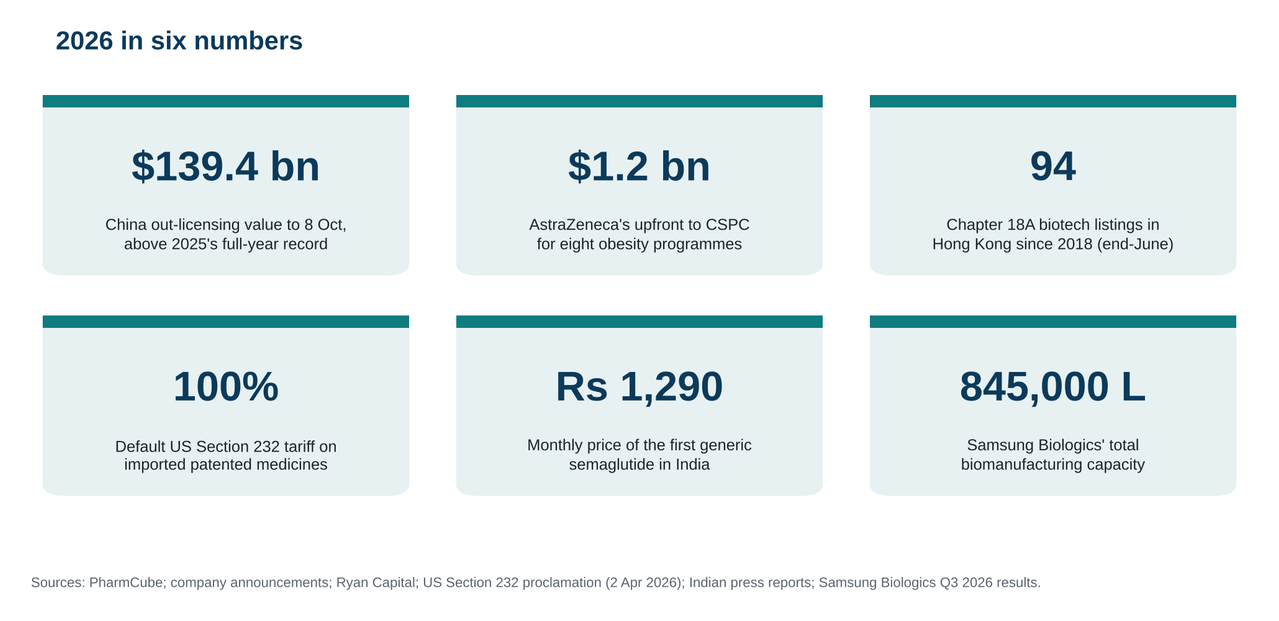
So this is not a list of what happened. It is an argument. Asia set more of the terms in 2026 than at any point in its biotech history. The question for 2027 is whether it can keep doing so when deal budgets tighten, policy deadlines land and the easy wins are behind it. Here is how the year unfolded, force by force.
If one chart defines Asian biotech in 2026, it is the one that tracks China's licensing tally climbing month after month.
The pace was set early. By late February, China-originated out-licensing had already reached $52 billion across 41 transactions, according to figures reported by the South China Morning Post. By the end of March, preliminary statistics from the National Medical Products Administration (NMPA) put the first-quarter total above $60 billion. By the end of June, the half-year figure stood at roughly $110 billion across 81 deals, a record for any six-month period. In other words, China banked in six months most of what had taken all of 2025 to achieve.
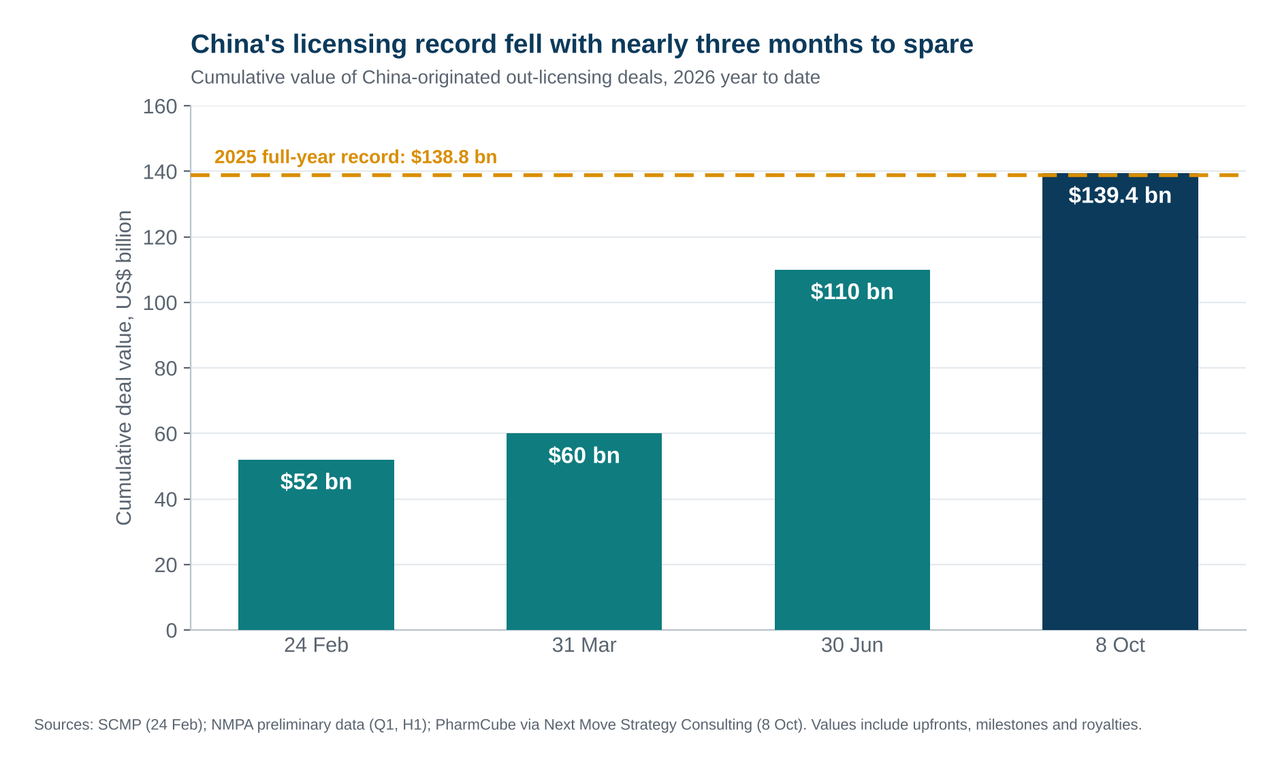
Figure 1. The record fell on 8 October, with almost a quarter of the year still to run.
What were global companies buying? Mostly the modalities in which Chinese labs have built a genuine lead. Antibody-drug conjugates (ADCs) are the clearest example: advisory firm Vision Lifesciences estimated in its 2026 outlook that China accounts for close to 90 per cent of global ADC licensing activity. Bispecific antibodies followed closely, with three Chinese bispecific projects alone attracting more than $8 billion in combined deal value in the first quarter. And then there was obesity.
At the end of January, AstraZeneca agreed to pay CSPC Pharmaceutical Group $1.2 billion upfront for access to eight obesity and type 2 diabetes programmes, with up to $3.5 billion more in development and regulatory milestones, plus commercial milestones and tiered royalties. CSPC kept the rights in mainland China, Hong Kong, Macau and Taiwan.
The size of that upfront mattered more than any headline total. For years, sceptics dismissed China deals as milestone theatre: large announced values, small cheques on signing. In 2026 the cheques got bigger. Evaluate data reported by Fierce Biotech shows the average upfront payment on China-to-West licensing rising from around $52 million in 2022 to about $172 million in 2026.
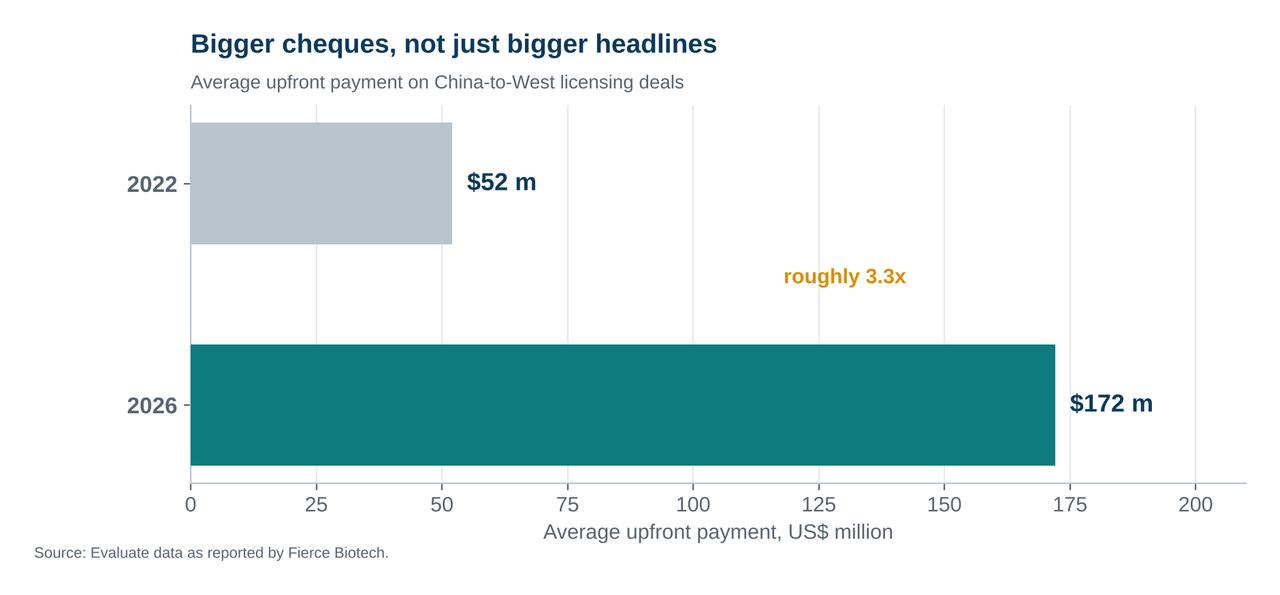
Figure 2. Upfronts are the part of a deal that actually lands on the balance sheet.
That cash changed balance sheets. Record cross-border deals helped some Chinese biotechs that had never turned a profit move into the black in the first half of the year, as the South China Morning Post reported in August. Licensing stopped being an exit strategy and became a funding model.
By the second half, though, a note of caution had crept in. The same reporting flagged that several multinationals were signalling plans to tighten their deal budgets. Patent cliffs have not gone away, so demand will not vanish, but buyers are becoming choosier, and Chinese sellers, who have learned to ask for higher valuations, may find negotiations slower in 2027. The record is real. Whether it marks a new floor or a high-water mark is one of the year's genuinely open questions.
|
Licensing stopped being an exit strategy for Chinese biotechs and became a funding model. |
Licensing money gave Asian biotechs one way to fund themselves. Public markets, after years of drought, offered another.
Hong Kong was the comeback story. KPMG described the first half of 2026 as the city's strongest first-half IPO performance in five years, and biotech rode the wave. Eleven pre-revenue biotechs listed under the Chapter 18A regime in the first six months, raising about HK$12.5 billion, according to Ryan Capital's tally. That took the cumulative total of 18A listings since 2018 to 94, and at the end of June another 38 applications were still live. The previous year had already reset expectations: by mid-December 2025, 13 biotechs had raised a combined HK$50 billion under 18A, against just four listings in 2024.
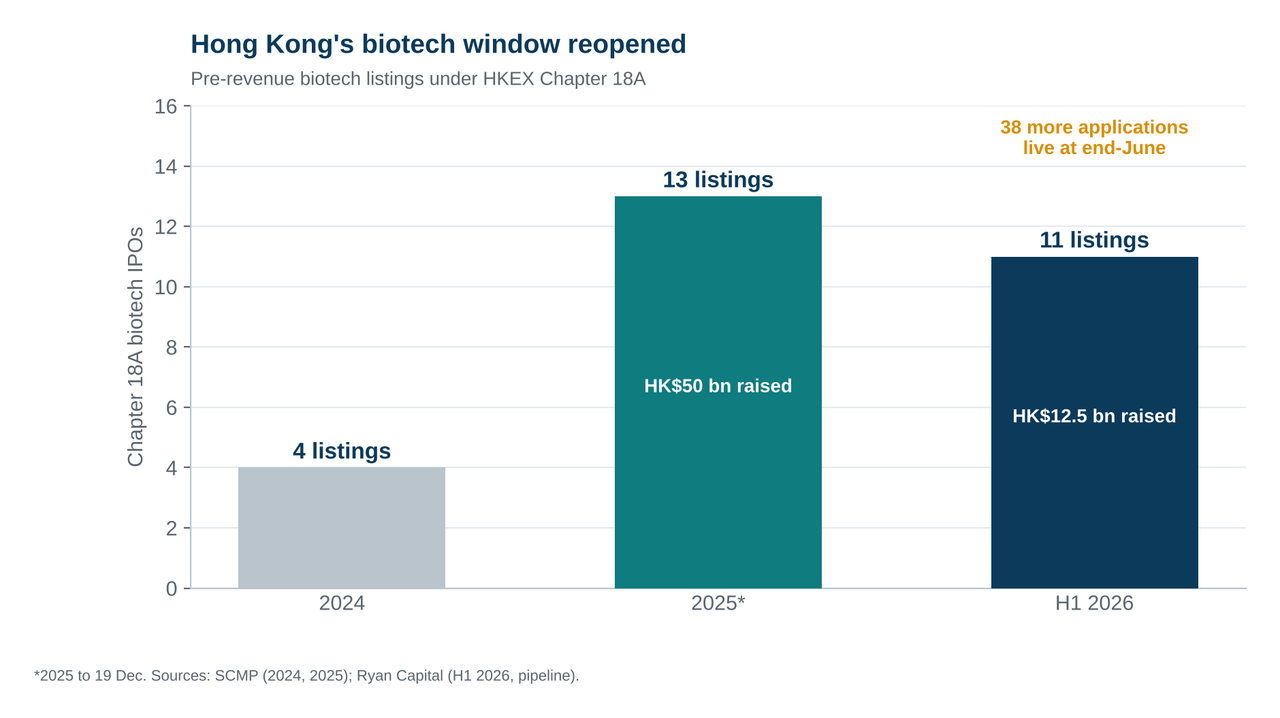
Figure 3. From four listings in 2024 to a queue of dozens: Hong Kong's specialist board is open again.
Two things made this cycle different from the 2018 to 2021 boom. First, the pathway has matured. Confidential filings now let companies prepare quietly, and investors have years of data on how 18A stocks behave after debut. Second, the issuer list is broadening. Law firm DLA Piper noted that Western biotechs had begun filing confidentially for Hong Kong listings, describing a city re-emerging as a listing venue of first choice rather than a last resort. AI-driven drug discovery reached public markets in style too, with Insilico Medicine's Hong Kong debut, which BioSpectrum Asia reported as the city's largest biotech IPO.
The money, however, was not evenly spread. Around BIO Asia Taiwan in July, investors described a barbell market: capital flowing to late-stage assets and proven platforms at one end, while the middle of the pipeline was left to fend for itself. That pattern held across the region. Hot stories found eager buyers, and everyone else found patient negotiations and tougher terms. For founders, the lesson of 2026 is simple to state and hard to execute. The market will pay for evidence, not for promise.
If deals and capital were Asia's tailwind, US policy was the crosswind every company had to fly through.
On 2 April 2026, exactly one year after the 'Liberation Day' tariffs, President Trump signed a proclamation under Section 232 of the Trade Expansion Act imposing duties on imported patented pharmaceuticals and their ingredients. It was the first time this national security authority, traditionally used for steel and aluminium, had been turned on medicines. The headline rate was 100 per cent. The fine print is where Asia's story lies.
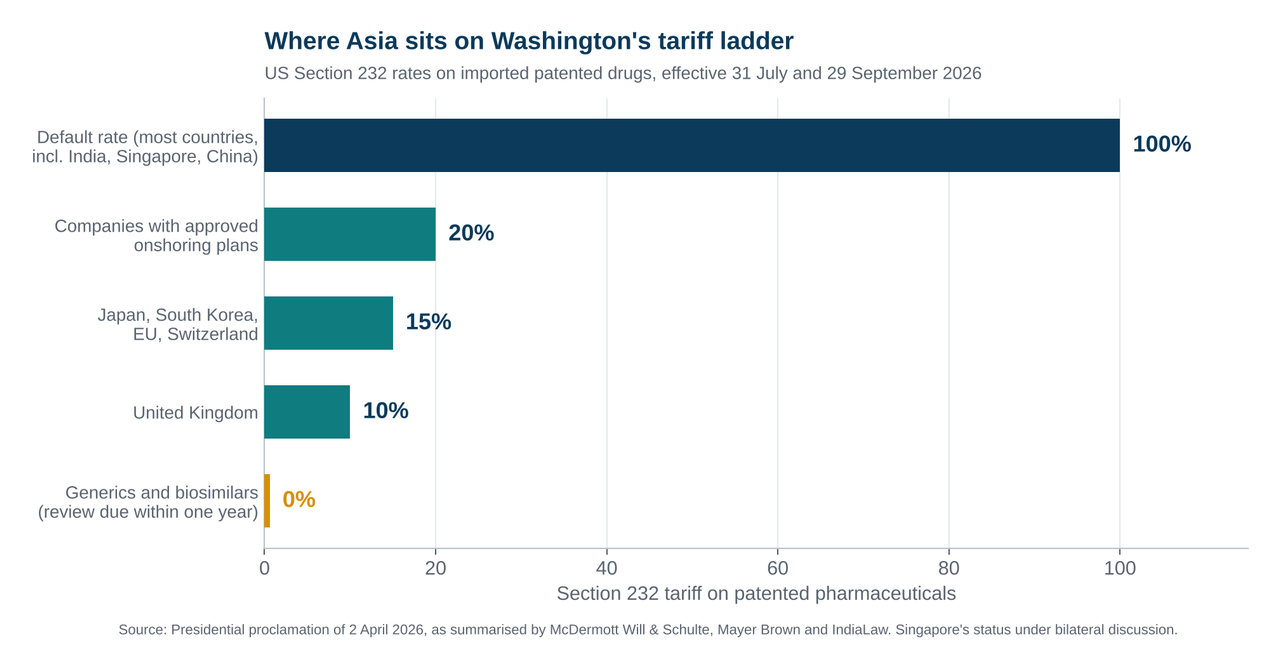
Figure 4. Deal rates, onshoring discounts and a generics carve-out turned one tariff into a ladder.
Products from countries that had already struck trade deals with Washington, including Japan and South Korea alongside the EU and Switzerland, face a 15 per cent rate. The UK secured 10 per cent. Companies with Commerce-approved onshoring plans can drop to 20 per cent. Generic medicines and biosimilars, along with their ingredients, were explicitly left out, at least for now. The tariffs took effect on 31 July for a list of large named companies and on 29 September for everyone else.
For Asia, that structure creates an unusual map. Japan and Korea are protected by their deal rates. India, whose US exports are overwhelmingly generics and the ingredients that go into them, is shielded for the time being. China's innovators earn much of their Western income through licensing rather than shipping finished patented drugs, which blunts the direct impact. Singapore, a significant supplier of patented medicines to the US, spent much of the year with its position under bilateral discussion. As BioSpectrum Asia's own analysis argued earlier this year, most of Asia's pharma trade is sheltered from the tariff, and that is exactly why the region should worry: sheltered is not the same as safe.
Two clocks are now ticking. The proclamation requires the Secretary of Commerce to report within a year on whether action is needed on generic imports. That deadline, which falls by April 2027, is the most consequential policy date on India's calendar. Meanwhile, the White House has claimed that roughly $400 billion in new pharmaceutical investment commitments materialised in response to the tariffs, which tells you exactly where the administration wants the factories to go.
The second lever was BIOSECURE. After failing twice, the act became law in December 2025 as part of the FY2026 National Defense Authorization Act. It restricts US federal agencies from procuring biotechnology equipment or services from designated biotechnology companies of concern, and the official list is due by December 2026. So far, the measurable revenue impact on China's largest contract research and manufacturing groups has been more limited than many predicted, and they continue to forecast growth. But a de facto BIOSECURE effect, in which sponsors quietly add non-Chinese backup suppliers before any law forces them to, was visible all year. And that effect created winners.
|
Most of Asia's pharma trade is sheltered from the US tariff. Sheltered is not the same as safe. |
For years, China plus one was a slide in a strategy deck. In 2026 it became purchase orders.
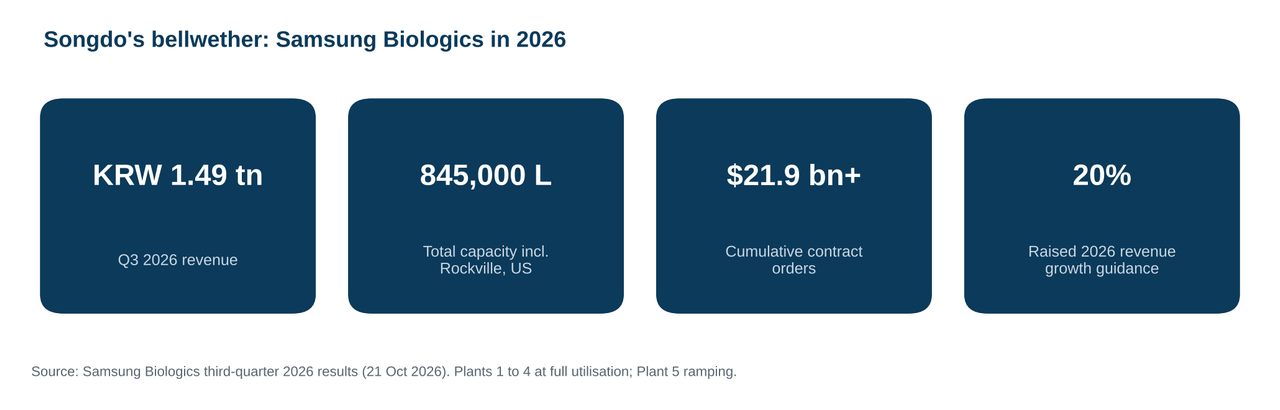
Korea is the clearest beneficiary. Samsung Biologics, the bellwether of the Songdo cluster, reported third-quarter revenue of KRW 1.49 trillion, with its first four plants running at full capacity and Plant 5 ramping up. Its total capacity now stands at 845,000 litres, including 785,000 litres across its two Korean campuses and 60,000 litres at its newly acquired site in Rockville, Maryland, which contributed revenue for the first time. Cumulative contract orders exceed $21.9 billion, and the company raised its 2026 revenue growth guidance to 20 per cent. In October it also cleared the acceptance threshold in its tender offer for peptide manufacturer PolyPeptide Group, extending its reach beyond biologics.
That Rockville site deserves attention. Korea's contract manufacturers are increasingly pairing large-scale Asian capacity with a US footprint, a dual-geography model that answers both BIOSECURE anxieties and tariff logic in a single move.
India's opportunity sits in a different part of the value chain. A Jefferies report estimated that the China plus one shift represents roughly $700 million a year in incremental revenue for Indian contract research, development and manufacturing organisations (CRDMOs), with BIOSECURE acting as a key catalyst. The gains should flow disproportionately to companies strong in small molecules and peptides. Indian firms also bought capability abroad: in September, Gujarat Themis Biosyn completed its acquisition of Japan's MicroBiopharm, adding fermentation expertise to its portfolio.
None of this means Chinese manufacturing is retreating. China's CDMOs remain enormous, efficient and deeply embedded in global pipelines. What changed in 2026 is that sponsors stopped treating a single-country supply chain as an acceptable risk. The winners of the year were not those who replaced China, but those who made themselves the obvious second answer.
On 20 March 2026, a patent expired in India and the economics of the world's most talked-about drug class changed overnight.
Semaglutide, the molecule behind Novo Nordisk's Ozempic and Wegovy, lost its core patent protection in India while remaining protected in the US and Europe into the 2030s. That made India one of the first major markets where generics could compete freely, and Indian companies were ready. Natco Pharma, with marketing partner Eris Lifesciences, launched on day one with a vial priced at Rs 1,290 a month. Sun Pharma, Zydus Lifesciences and Dr Reddy's Laboratories followed almost immediately, with Torrent, Alkem, USV, Glenmark and others close behind. Industry estimates suggested that more than 40 Indian companies were preparing over 50 generic versions.
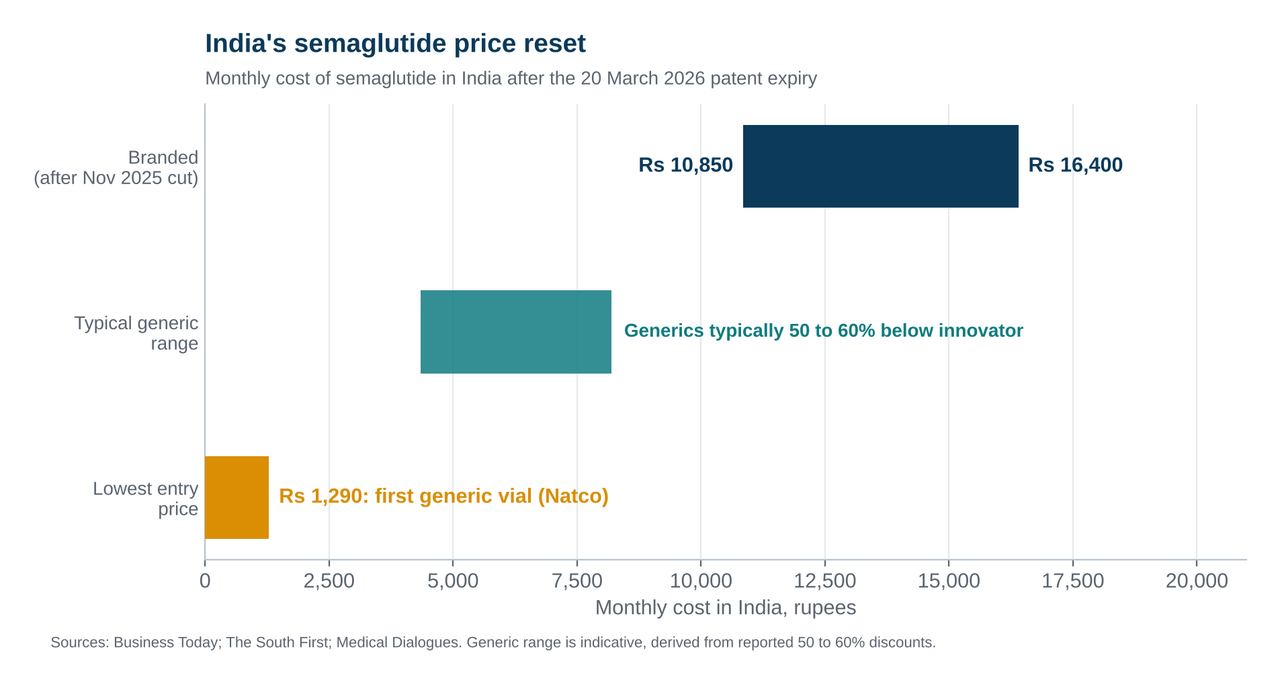
Figure 5. Even after Novo Nordisk's pre-emptive price cut, generics reset what Indian patients pay.
The price gap is the story. Even after Novo Nordisk cut prices by up to 37 per cent in November 2025 to prepare for competition, branded semaglutide cost between Rs 10,850 and Rs 16,400 a month depending on dose. Generics arrived at roughly 50 to 60 per cent below innovator prices, and Natco's entry point was far lower still. In a country where more than 100 million people live with diabetes, that is not a marginal improvement. It changes who can be treated at all.
The ambition reaches well beyond India's borders. Dr Reddy's announced plans for 12 million pens in its first year and is targeting 87 countries as patents fall around the world. Researchers estimate that by the end of 2026, core semaglutide patents will have expired in 10 countries that together carry 48 per cent of the global obesity burden. And because India already supplies more than half of Africa's generic medicines, the downstream effect on access could be profound.
Two caveats are worth stating plainly. First, competition is fierce at the innovative end too: Eli Lilly's Mounjaro became India's top-selling drug by value within months of launch, and tirzepatide is not part of the semaglutide patent story. Second, a market with 50 brands raises fair questions about uneven quality oversight. India's semaglutide moment will be judged not by how many companies launched, but by how many can sustain quality at scale and pass the scrutiny of regulated export markets.
|
India's semaglutide moment will be judged not by how many companies launched, but by how many can sustain quality at scale. |
China, India, Korea and Hong Kong dominated the headlines, but the year had more chapters than that.
Japan spent 2026 repositioning biopharma as a strategic priority through pricing reform, R&D funding and support for start-ups, with venture creation initiatives such as Saisei Ventures' bridge-to-biotech programme aiming to turn academic science into companies. Its 15 per cent tariff deal gave exporters breathing room, and the next test arrives with the FY2027 off-year drug price revision.
Singapore remained the region's trusted hub for high-value manufacturing and regional headquarters, even as its US tariff status became one of the year's most watched open items. Taiwan used BIO Asia Taiwan in July to signal an outward push, pairing AI-led discovery with global partnering. Australia kept its role as Asia's early-stage clinical engine, while ASEAN markets including Thailand, Vietnam and Malaysia moved steadily on manufacturing incentives and market access. Here is how the region scores.
|
Market |
What 2026 looked like |
Verdict |
The 2027 test |
|
China |
Licensing record broken by 8 October; NMPA approvals accelerate; licensing income turns some biotechs profitable |
Surged |
BIOSECURE list; tighter MNC deal budgets |
|
India |
Semaglutide generics from 20 March; CRDMOs gain from China+1; generics shielded from US tariffs |
Surged |
US generics review due by April 2027 |
|
South Korea |
Samsung Biologics at full utilisation; 15% US tariff deal; US footprint via Rockville |
Surged |
Plant 5 ramp-up and Bio Campus III |
|
Hong Kong |
11 biotech IPOs under 18A in H1; Western issuers filing confidentially |
Surged |
Can the 18A queue convert? |
|
Japan |
15% tariff deal; pricing and start-up reforms; venture creation |
Steady |
FY2027 off-year price revision |
|
Singapore |
Trusted hub for high-value manufacturing; US tariff status under discussion |
Watch |
Outcome of bilateral talks |
|
Taiwan |
Outward push showcased at BIO Asia Taiwan; AI-led discovery funding |
Steady |
Partnering turning into deals |
|
Australia |
Asia's early-stage clinical engine |
Steady |
Capital for scale-ups |
|
ASEAN |
Manufacturing incentives and market access moves in Thailand, Vietnam, Malaysia |
Watch |
Regulatory harmonisation |
Verdicts are BioSpectrum Asia's editorial assessment of each market's momentum in 2026.
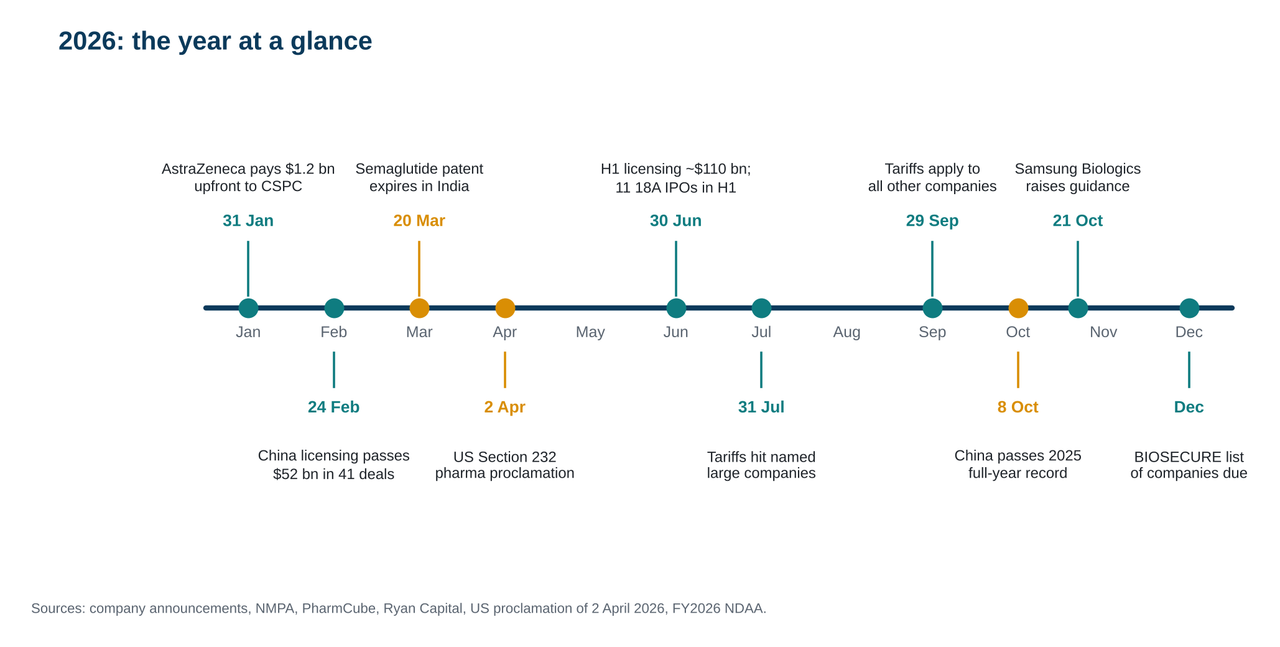
Figure 6. Twelve months, ten turning points.
Strip away the numbers and 2026 leaves Asia's life sciences leaders with five practical lessons.
Price your science like it is scarce. The rise in upfronts shows that Western buyers will pay real money for differentiated assets. Companies that negotiate as if they are selling surplus inventory leave value on the table. The ones that won this year came to the table with clean data packages, clear global development plans and alternatives in hand.
Treat geography as a product feature. A drug, a batch or a service now carries a passport, and that passport affects its price. Korea's dual-geography manufacturing model and India's generics carve-out both show that where something is made, and under which agreement it crosses a border, has become part of what a customer is buying.
Fund the middle of the pipeline differently. The barbell market is not going away soon. Mid-stage companies that wait for a generalist IPO window may wait a long time. Partnering, structured regional rights deals and specialist crossover rounds are likely to do more of the heavy lifting in 2027.
Make quality the competitive moat. India's semaglutide wave and the China plus one shift both reward manufacturers whose quality systems can withstand an inspection by any regulator, anywhere. In a crowded market, compliance is not a cost centre. It is the reason a buyer picks you over the next supplier.
Plan for the policy calendar, not the policy headlines. The BIOSECURE list, the generics review and Japan's price revision all have dates attached. Leadership teams that map those dates against their own pipelines, contracts and capacity plans now will spend 2027 executing rather than reacting.
Leverage, once gained, has to be defended. These are the dates and triggers that will decide whether Asia keeps the terms it set in 2026.
When BioSpectrum Asia published its first issue two decades ago, the region's biotech story was mostly about cost: cheaper chemistry, cheaper trials, cheaper tablets. Twenty years on, it is a story about value. 2026 was the year that shift became impossible to ignore, in the size of the cheques, the queues at the Hong Kong exchange, the full order books in Songdo and the price tags on India's pharmacy shelves.
But leverage is not a permanent possession. It is earned, and then it has to be defended. In 2027 that defence will not come from bigger headline numbers. It will come from quality that holds up to scrutiny, regulators that earn the trust of their counterparts abroad, and companies that turn licensing deals into approved medicines. The region has proved it can set the terms. Next year it has to prove it can live up to them.
ankit.kankar@mmactiv.com


