Panel discussion highlighted the transformative potential of digital health in reshaping care delivery. Innovations such as remote monitoring, AI-driven diagnostics, and personalized care platforms are driving a shift toward prevention and personalization. However, adopting these technologies faces challenges, including resistance from traditional healthcare systems, clinician skepticism, and operational complexities. Scaling these innovations requires persistence, adaptability, and demonstrating value through practical prototypes and controlled testing environments like sandboxes. Experts discussed strategies to streamline diagnostics, empower patients, and ease pressure on health systems.
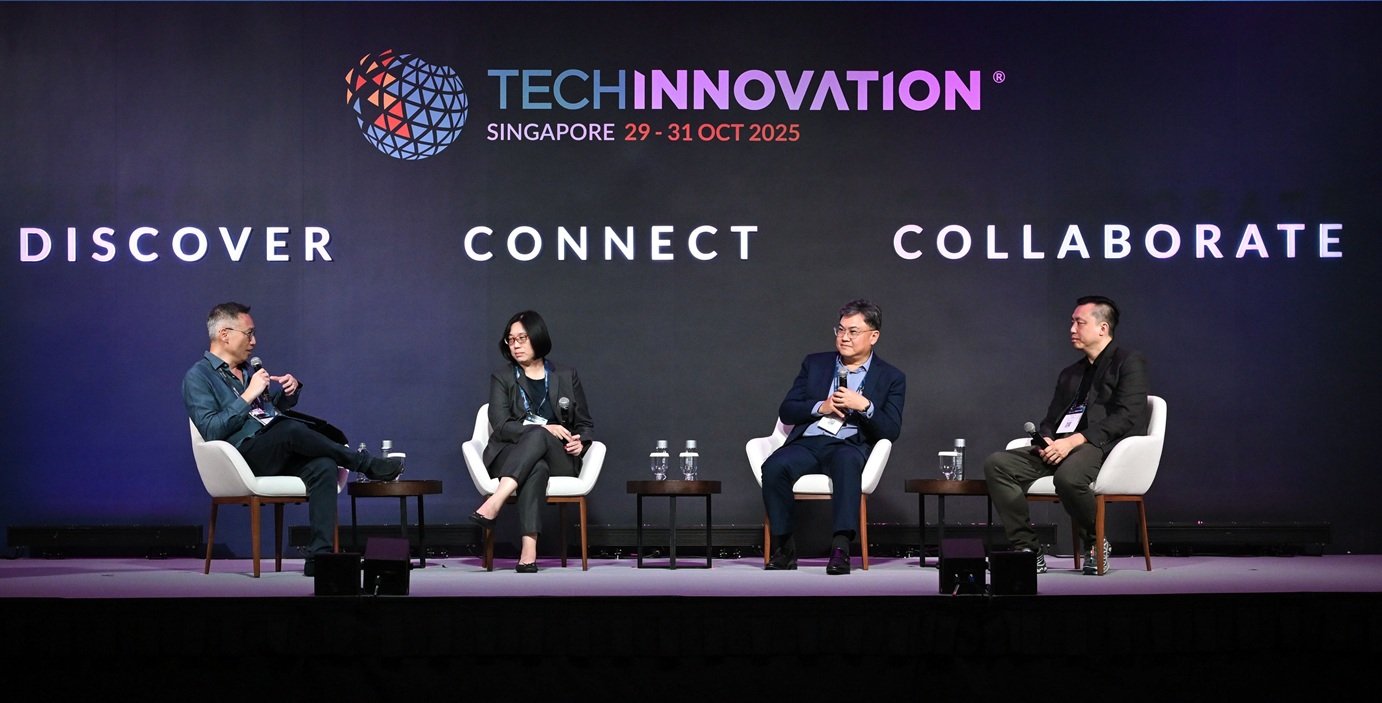
Image credit: TechInnovation 2025
(From From left to right)
Healthcare is undergoing a transformative shift, redefining how care is delivered by making the home a central hub for preventive and personalized digital care. This paradigm shift not only redefines traditional care models but also emphasizes the importance of preventive and personalized digital care. This transition emphasizes accessibility, convenience, and tailored solutions by leveraging innovative technologies to bring essential services directly to patients. By using tools like continuous monitoring systems and smartphones, healthcare providers are now empowered with technology that streamline diagnosis and monitoring, addressing challenges such as long wait times and limited accessibility in traditional systems.
Even in developed countries like Singapore, healthcare accessibility is one of the greatest challenges—getting a diagnosis often involves long waiting periods for appointments and multiple tests. In Singapore, Initiatives like the Mobile Inpatient Care @ Home (MIC@Home) exemplify the current evolution in trend, by integrating remote monitoring and secure data transmission to enhance care delivery and redefine traditional models. Healthcare providers are now able to deliver essential services directly to patients, revolutionizing care delivery through innovative strategies and capabilities.
At the TechInnovation 2025 forum in Singapore, innovators and investors discussed home-based healthcare in an intriguing panel discussion, presenting ideas and concepts that connect and enhance these experiences.
Dr Philip Wong: Scaling health technology innovations is challenging, as startup innovators often face resistance from traditional healthcare systems, particularly from clinicians and funders. Convincing stakeholders, especially doctors accustomed to traditional methods, requires persistence, adaptability, and a clear demonstration of value through analyses and practical prototypes.
Scaling health technology innovations requires navigating multiple stages, from formulating ideas and conducting value analyses to developing practical, low-cost prototypes. Selling these concepts, especially to financial stakeholders unfamiliar with healthcare, is challenging and may require explaining basic financial metrics like P&L. Success depends on persistence, adaptability, and effectively demonstrating value.
The traditional healthcare system faces challenges in adopting new technologies, particularly due to clinician resistance and the complexity of scaling innovations. Doctors are accustomed to traditional methods, and the public sector often involves lengthy diagnostic processes. For instance, diagnosing heart arrhythmias in the public sector traditionally involved long wait times, multiple hospital visits, often failing to detect issues due to short monitoring periods. To address this, a system was developed to use cell phones for transmitting ECG data directly to servers, streamlining the process and eliminating the need for repeated hospital visits.
Dr Goh Su-Yen: The public healthcare system faces significant challenges, including the slow adoption of innovative ideas like home-based healthcare. The COVID-19 pandemic highlighted the necessity of this shift, but implementing changes such as managing patient-reported data, home monitoring, and remote physiological monitoring remains complex. Medicine's risk aversion further hinders the timely adoption of new approaches.
Adopting novel technology requires minimizing risks and ensuring safety. Governance and the creation of sandboxes—controlled environments for testing and scaling new technologies—are essential to assess and implement innovations effectively.
The Mobile Inpatient Care @ Home (MIC@Home) initiative began in a sandbox environment, which is crucial for safely testing and scaling new technologies like AI, SAMD, and remote physiological monitoring. Sandboxes enable rapid assessment, quick learning, and the ability to discontinue if needed, representing significant progress despite challenges ahead.
Dr Goh Su-Yen: The hospital-at-home model has evolved significantly, especially during COVID-19, by integrating systems to provide seamless care. Traditional inpatient services like intravenous therapy are being adapted for home use. However, it requires multiple components, including remote monitoring, secure two-way communication, and data transfer systems that comply with strict privacy regulations.
Technological advancements, such as ambient sensors, glucose monitors, and AI-assisted triaging, have been the game changer aiming to enhance care, though challenges like limited 24/7 support and reliance on third-party services remain. The system has improved with dashboards and monitoring teams, focusing on physiological red flags and exploring ambient monitoring to ease patient burden.
Adopting hospital-at-home models faces challenges like physician and patient acceptance, with physicians often more resistant despite patient enthusiasm. Success depends on balancing impact, risk, and feasibility to deliver effective, home-based care.
Adopting hospital-at-home models presents significant challenges, including resistance from physicians and varying levels of patient acceptance. While patients often embrace these models more readily, implementing these models requires addressing physician concerns, such as increased workload and time demands. The approach depends on the hospital's priorities—whether to focus on simpler conditions like dengue or to explore advanced, high-risk care such as chemotherapy or organ transplants at home. Success hinges on carefully balancing the potential impact, associated risks, and practical feasibility to provide effective, patient-centered care in a home setting.
Dr Yong Chern Chet: Health tech differs significantly from other technology sectors due to the unique challenges of the healthcare system. Unlike traditional tech ventures that thrive on disruption and rapid scaling, healthcare startups must navigate a more cautious and incremental approach, akin to the metamorphosis of a butterfly. Investments in this space often focus on augmenting existing capabilities rather than creating entirely new markets, as the reimbursement-driven revenue model limits the potential for high-risk, high-reward innovation. To scale effectively, remote monitoring technologies must align with the traditional healthcare framework while addressing practical challenges like physician acceptance and reimbursement accessibility. Success in this space requires addressing prevailing concerns, such as improving facility-based care, while also exploring opportunities in preventive and personalized care. This shift involves moving from reactive care (push) to proactive engagement (pull), enabled by advancements like ambient sensors, AI-assisted triaging, and remote monitoring technologies.
Technology is shifting the traditional healthcare model by enabling early diagnosis and pre-screening through data streams and feeds, moving beyond the reliance on physical examinations. This transformation requires a rethinking of clinical practices and the adoption of new frameworks. Three key areas need to be considered;
There is a need to rethink healthcare delivery through three key aspects: provision (how care is funded and accessed), procurement (how care is distributed and delivered, whether through platforms, smart homes, or clinics), and practice (how doctors adopt early intervention platforms for individuals who are not yet patients). This approach bridges the gap between traditional care models and emerging technologies, offering opportunities valued between the early double digits and up to 50-80 from an investor's perspective.
Dr Yong Chern Chet: In facility-based healthcare, technology adoption often depends on procurement cycles and financial budgeting, typically involving CAPEX investments. These investments, such as advanced imaging machines, are subject to depreciation schedules, often spanning 10 years, which can create an artificial delay in upgrading or replacing technology. In contrast, adopting a SaaS or opex-based model allows for more flexibility, enabling quicker upgrades and reflecting a shift in how healthcare technologies are financed and deployed.
Dr Philip Wong: The transformative role of AI in healthcare, is its ability to analyze vast amounts of cardiac data quickly and accurately. The three critical aspects of healthcare technology: precision in data collection, personalized medicine tailored to individual needs, and predictive medicine that provides early warnings, such as the likelihood of conditions like atrial fibrillation (AF) are the game changers for modern medical care requirements. AI enables rapid analysis of data, such as 80,000 daily heartbeats, and facilitates preventive measures by identifying risks and suggesting interventions, such as lifestyle changes to reduce AF. AI plays a significant role in analyzing large volumes of data quickly; for instance, while a physician might analyze a 12-lead ECG in 5 minutes, AI can process 30,000 ECGs in seconds. Predictive medicine uses this data to forecast conditions like atrial fibrillation (AF), offering early warnings and preventive strategies for future health risks. Additionally, AI's ability to analyze vast datasets quickly and predict outcomes efficiently can also reduce the need for extensive human resources in data monitoring centers, making healthcare more scalable, resource-efficient and cost-effective.
Dr Goh Su-Yen: Emergency departments are often overwhelmed with patients and ambulance ramping. To shift patient behavior to embrace triage before seeking medical attention, a significant mindset change is needed, as patients are often determined to receive immediate care and reluctant to see anyone other than a doctor. Various strategies, including telemedicine booths in emergency departments, have been tested, offering quicker access via teleconsultation compared to waiting hours for in-person care. The key question remains whether people can trust such triage systems and adopt them effectively.
Generative AI tools, such as ambient AI scribes, are transforming healthcare by reducing the cognitive load on providers. These tools assist in documenting patient interactions by converting voice to text and generating reports, saving significant time for healthcare staff, enabling healthcare professionals to focus more on patients rather than manual documentation tasks. This is particularly beneficial in home monitoring scenarios, where nurses and doctors often spend significant time documenting patient interactions. By streamlining documentation, AI scribes allow providers to focus more on patient care and less on administrative tasks, improving overall efficiency in healthcare delivery. Nevertheless, it is important to recognize that these tools are not a comprehensive solution and are dependent on human oversight.
Dr Goh Su-Yen: Not everything a physician thinks during a patient examination is articulated, making it challenging to capture all relevant details. Training healthcare providers to better articulate their observations is essential, as unspoken thoughts may be lost. The ambient AI scribes are valuable tools for reducing cognitive load by automating documentation through voice-to-text and text-to-text processes. These tools have been widely embraced because of their clear utility in saving time and effort, particularly in administrative tasks like meeting minutes or patient reports.
To ensure widespread adoption, the technology is being introduced in stages, beginning with desktop and mobile applications, to enhance digital literacy among healthcare staff and optimize its use across various clinical settings. This phased approach is critical for enabling healthcare providers to effectively utilize generative AI tools. AI scribes play a key role in reducing cognitive load by automating documentation through voice-to-text and text-to-text processes, significantly saving time for doctors and nurses, particularly in home monitoring scenarios.
Dr Nelson Lau: The efficiency of AI scribing in reducing the time spent on documentation is empowering, particularly in home monitoring scenarios where staff, including nurses, spend significant time documenting patient interactions. This is especially beneficial for elderly patients.
Dr Philip Wong: Digital health avatars, which are 3D visual representations of a patient's body, display all their health conditions in one view. These avatars allow physicians to quickly understand a patient's health status without scrolling through extensive data like biochemistry reports or CT scans. The potential for these avatars can be used in triaging patients, where the avatar can be transmitted from the patient's phone to the physician, enabling the creation of personal health records and risk profiling. This could allow healthcare facilities to prioritize patients based on their health data, to identify those needing urgent care, like heart attack patients. As the future unfolds, these avatars can potentially revolutionise predictive care, helping to monitor and predict health risks, allowing for earlier interventions and prevention of diseases.
Similarly, Cloud technologies are crucial in healthcare as they enable real-time data streaming from anywhere. Despite challenges like institutional resistance, the benefits are significant, including rapid data transmission and the ability to perform remote surgeries using advanced 5G/6G networks. These technologies are essential for the future of healthcare, as they facilitate faster and more efficient data sharing, while also supporting emerging innovations like AI and robotics in clinical practice.
The current ECG monitoring system uses algorithms to detect rhythms and alert patients, such as notifying them to see a physician if atrial fibrillation (AF) is detected. In the future, AI will enhance this by identifying markers in normal ECG readings that predict risks like ischemic events (ILS). The AI will provide alerts and suggest preventive interventions, enabling early detection. This integration of continuous monitoring and AI-driven alerts aims to improve prevention and overall healthcare outcomes.
Dr Goh Su-Yen: Digital twins have tremendous potential in healthcare, particularly in the areas of prediction and prevention. By using patient data, such as glucose levels or biochemistry reports, and matching it with scientific evidence, digital twins can help predict disease progression and recommend timely interventions. For example, in diabetes care, digital twins can assist in prescribing drugs like SGLT2 or GLP1 to bend the curve of disease progression. However, the challenge lies in integration, as the data must be effectively analyzed and acted upon to change both patient and prescriber behavior. Without proper integration, the data remains underutilized, limiting its impact on clinical practice
In most cases, it's also challenging to manage the overwhelming amount of data generated by continuous health monitoring devices. The key is to make the data smart and actionable, ensuring that it is presented in a way that empowers both patients and providers to take effective action. This approach, referred to as 'setting them up for success,' is essential for improving patient outcomes and preventing stress with the data overload.
Dr Yong Chern Chet: I believe the best way to categorize these technologies is by focusing on the innovations driven by digital advancements and the increasing availability of health-related data. Over the next three to five years, I hope we can establish a standard for interoperability. Because we still lack an international standard for health interoperability at the application level. This would allow individuals to manage their critical health data, stored on personal devices like smartphones or wearables, while enabling temporary access for healthcare providers during emergencies.
We can anticipate two major trends in healthcare technology.
First, within the next three to five years, advancements in digital health will focus on making health-related data more accessible and actionable. A key aspiration is achieving international interoperability standards, allowing individuals to control their health data—stored locally on devices like smartphones or wearables—while enabling temporary, on-demand access for healthcare providers during emergencies. Such a system, inspired by blockchain technology, could enhance trust, security, and the effectiveness of AI in improving healthcare outcomes.
Second, looking 10 to 15 years ahead, we anticipate the rise of embodied AI, where AI capabilities transition from software to hardware, such as robots or assistants. These technologies will work alongside healthcare practitioners, enhancing their capabilities and bridging the gap between digital and physical healthcare. This shift will transform traditional healthcare systems by integrating advanced AI into real-world clinical practices. Additionally, the role of genomics and epigenetics in leveraging AI for innovative therapies and disease management leads, positioning these as outputs driven by the foundational trends in data accessibility and AI integration.
Dr Yong Chern Chet: The evolving regulatory landscape for generative AI significantly impacts investment decisions in the healthcare technology sector. Regulators face challenges in addressing cutting-edge technologies due to the need for precedents and established frameworks. As a result, investors must diversify their focus and assess technologies based on their maturity and alignment with current regulatory stances.
For generative AI, investment strategies often prioritize foundational applications, such as administrative tasks, financing, and procurement, rather than direct patient treatment or automated diagnosis. This cautious approach ensures alignment with regulatory readiness while allowing for scalability.
Startups in this space face hurdles in obtaining regulatory approval for clinical decision-support AI, which can influence VC funding strategies. Investors must stay attuned to the rapid pace of technological advancements and regulatory updates to identify market-ready innovations. Success in health tech investing requires not only financial analysis but also a keen understanding of technological evolution and regulatory dynamics.
Dr Yong Chern Chet: I think we need to shift our mindset about AI in healthcare. It's neither overly simple nor overly complicated. While AI can monitor data and provide insights, trusting it completely is challenging, especially in critical situations. For instance, I wouldn't blindly trust an AI's call if it could lead to a serious situation without understanding my specific needs. However, if the AI has accurate readings, like accurately monitoring my health parameters, it gives me confidence in its reliability.
Dr Philip Wong: AI implementation involves multiple levels. Simple, rule-based AI can assist with tasks like determining how long to wear an ECG monitor based on risk factors, such as a high stroke score. This type of AI is straightforward to implement. On the other hand, advanced predictive AI, like deep neural networks analyzing large datasets of ECGs, is more complex, time-consuming, and costly to develop. So it depends on the level of AI you want to implement as well.